Master Wawp's Smart Rate Limiting Engine. Explore tailored safety policies, humanized delivery intervals, intelligent smart queues, and advanced concurrent worker management to scale without bans.
5 min read·Updated August 23, 2026
The single largest challenge when scaling WhatsApp automation is not successfully transmitting the message payload—it is avoiding the 'Robot' classification. If your API backend behaves like an unrestrained machine, instantly blasting bursts of payload packets in a matter of milliseconds, WhatsApp's heuristic filters will immediately flag and ban your connection.
At Wawp, we have designed an advanced, highly proactive Rate Limiting Engine that goes far beyond simple throttles. It acts as an intelligent proxy layer that "humanizes" your entire message distribution rhythm, securing your connected numbers while maintaining maximum operational throughput.
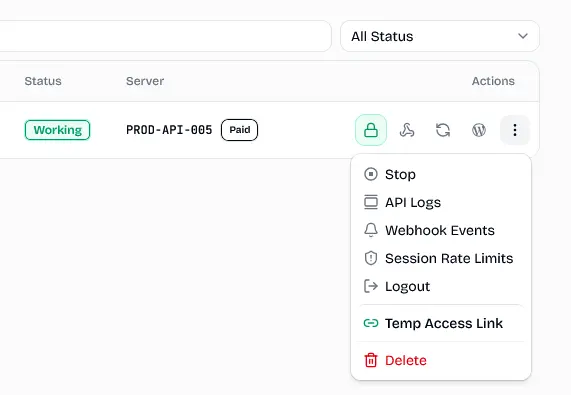
Accessing Session Rate Limits
Rate limits are configured independently per instance, allowing you to fine-tune pacing metrics according to the unique trust rating of each specific phone number.
1
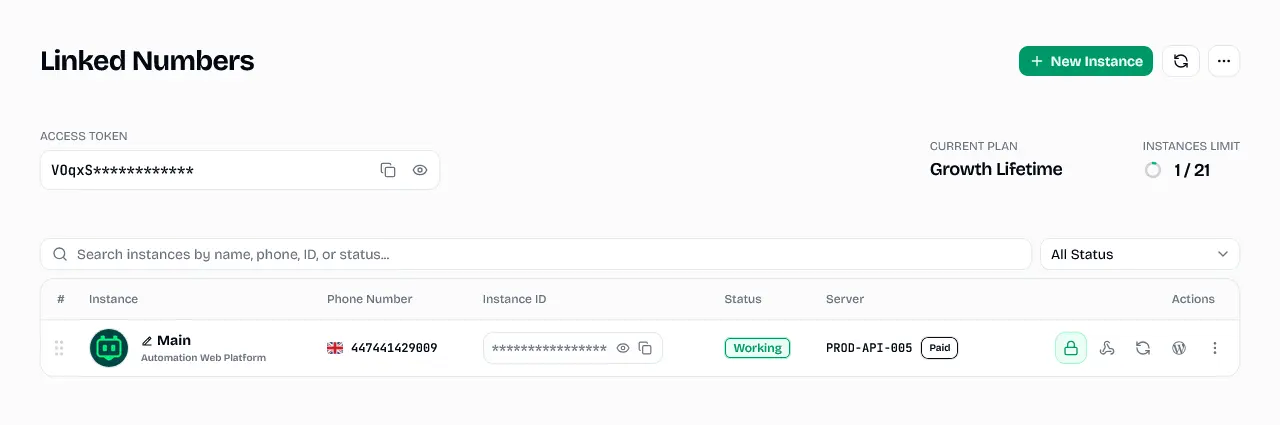
Open Linked Numbers Log into your core admin console and access the[Linked Numbers](https://app.wawp.net/linked-numbers) workspace control panel.
Linked Numbers Workspace
The primary administration console for managing WhatsApp instance connections and their individual settings.
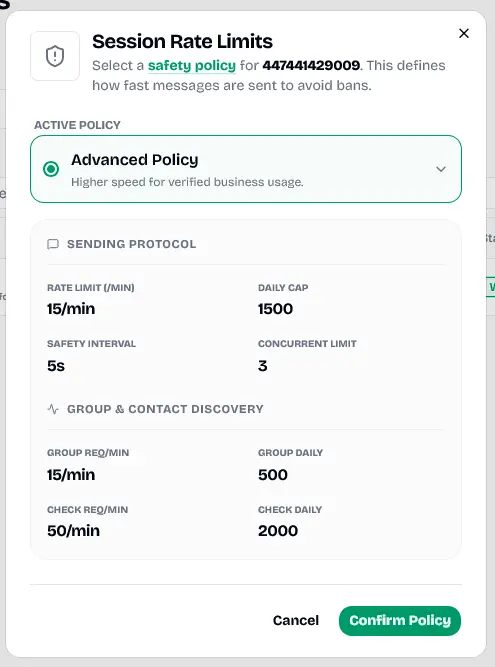
Upon opening the configuration dialog, you are presented with our guiding principle:
"Select a safety policy for your number. This defines how fast messages are sent to avoid bans."
Understanding Safety Policies & Their Impact
Every WhatsApp profile possesses a distinct account age, contact network depth, and trust score. To match your account lifecycle perfectly, Wawp supports granular, selectable Safety Policies.
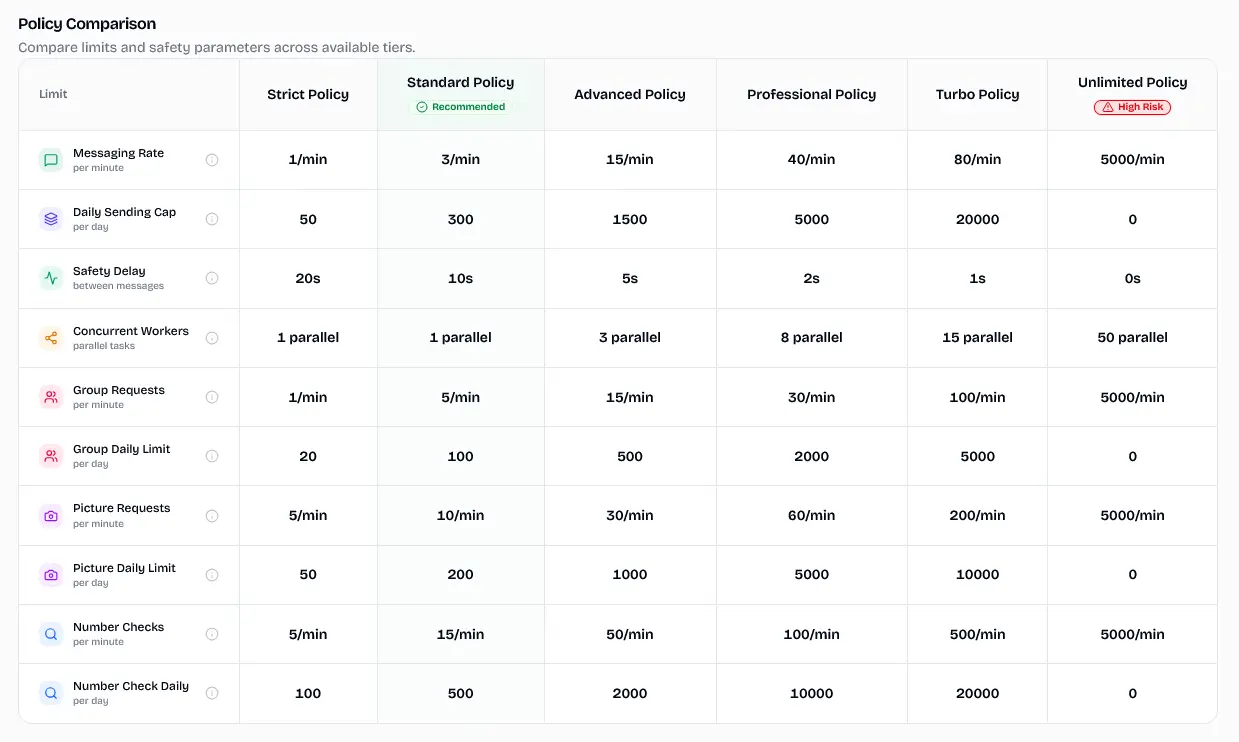
Review the breakdown below to understand the operational impact of each tier:
1. Strict Policy (Maximum Security)
Pacing Rhythm: Enforces a mandatory, highly consistent 20-second minimum safety gap between outgoing transmissions.
Operational Impact: Instantaneous API transmission feels slower, but it provides near-impenetrable structural protection against automated burst filters.
Pacing Rhythm: Applies optimized, variable intervals (e.g., standard baseline delays ranging dynamically between 5 to 10 seconds based on localized destination cluster loads).
Operational Impact: Strikes a premium balance between prompt responsiveness and systematic sender safety. Conversational workflows feel perfectly human.
Recommended For: Established customer support lines, standard tracking notifications, everyday e-commerce order status updates, and interactive button replies.
Operational Impact: Dispatches heavy volumes of inbound queue payloads almost instantaneously. However, using this mode bypasses standard protective throttling buffers.
Recommended For: Highly seasoned corporate sending lines with excellent domain standing, internal operations alerts, or heavily warmed-up long-term instances.
Safety Policies Impact Comparison
A visual breakdown of how Strict, Moderate, and Turbo policies affect delivery speed and sender safety.
⏳ What happens if an external trigger calls your API 100 times simultaneously? Unlike fragile architectures that return HTTP 429 Too Many Requests or drop database inserts, Wawp routes packets directly into a localized Smart Queue.
The Workflow: The initial outbound message fires instantly. Subsequent payloads automatically wait in line for the calculated safety window to clear before being pulled serially by worker daemons. Your end applications execute instantly without blocking threads.
2. Simulated Human Behavior 🧠
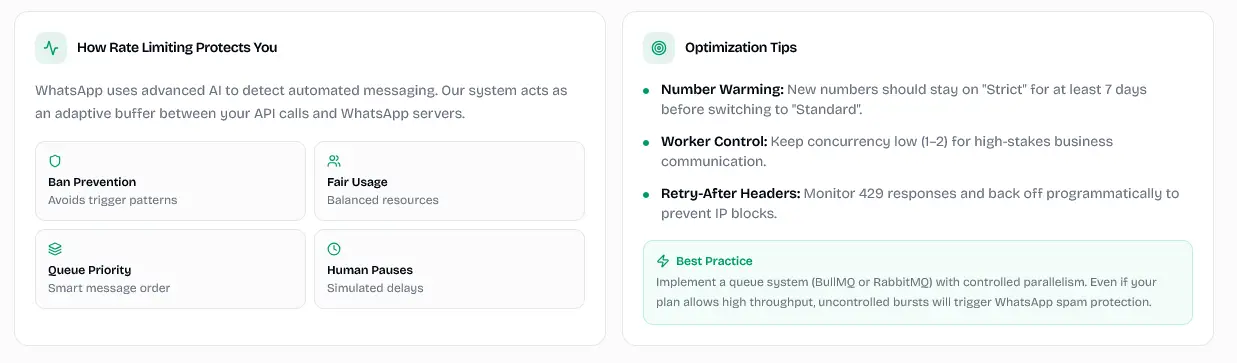
Authentic human users do not draft and upload complex attachments with binary precision. Our engine inserts smart "Human Pauses" (Safety Delays). It assesses file payloads in real-time—allocating extended buffer gaps for high-resolution images, videos, or raw PDFs compared to lightweight plain-text strings to match genuine client upload constraints.
3. Advanced Concurrency (Worker Control) ⚙️
Control exactly how many background daemons process your instance queues. By setting Concurrent Workers, you dictate total simultaneous connection streams:
Single Worker (1): Absolute serial pacing. One packet is pulled, finalized, and acknowledged before the next thread opens.
Multi-Worker Clusters (3 to 5): Multiple chat handshakes execute concurrently. Excellent for broadcasting high-priority operational updates across broad contact matrices safely.
Rate Limiting Core Pillars
An infographic illustrating the four core technologies behind Wawp's smart delivery engine: Queuing, Humanization, Concurrency, and Scaling.
The dialogue surrounding phone bans is the most transparent conversation we hold with our ecosystem developers. Our foundational objective is to make continuous transactional automation viable for independent brands who find official API pricing models cost-prohibitive.
The Efficiency Gap
Transmitting routine transactional packets—such as order state transitions, dual-factor authentication tokens (OTPs), or reservation confirmations—via official direct pricing models can easily exceed hundreds of dollars monthly. Wawp equips you with an optimized infrastructure to accomplish these identical daily operational tasks efficiently.
The Risk of Marketing Blasts
Conversely, utilizing raw session API engines to mass-distribute pure unsolicited promotional marketing blasts carries absolute ban certainty. Because marketing channels measure value through direct attribution ROI, our explicit recommendation remains: Always utilize the official WhatsApp Cloud API for bulk cold marketing blasts. It preserves your operational reputation flawlessly.
The Unified Hybrid Horizon
To give you complete command over both routing methodologies, our core platform engineering teams are actively developing dual-protocol integrations. Soon, you will be able to manage hybrid API pathways for identical sender numbers directly inside your master dashboard interface.